
Social Analysis
Social Matching in the Care Relationship
Good Souls uses Social Analysis, our social matching approach in the care relationship, to place strong emphasis on human values.
Social inclusion, shared activities, and cognitive stimulation can support the well-being of older people and are associated with positive health outcomes. Numerous scientific studies support what we can intuitively feel: shared interests and incorporating meaningful activities into everyday life can have a positive impact on us.
Good Souls’ Social Analysis is a structured process for identifying interests, hobbies, lifestyle habits, and social preferences. We provide this information alongside the usual professional and organizational selection criteria, helping to connect caregivers and care recipients through suitable personal points of connection. Why is this important?
When people in Germany talk about care, they discuss the care grade, care costs, care needs, technical infrastructure, language skills, and service providers. Care is approached in a factual and analytical way, and the processes are standardized. There are clear checklists designed to ensure good care. And all of this is important to us.
But what does “good human care” mean when we take a moment to think about it? Of course, all hygiene, medical, and care-related procedures must function smoothly. These are the basic principles of care. But do professional procedures alone also positively stimulate people’s quality of life and make them happier?
At Good Souls, we build on these scientific findings and, in addition to general care standards, also consider the interpersonal and cognitive impact of care. We believe that engaging in hobbies that people have cherished for decades can improve patients’ well-being and help preserve their sense of self-worth.
It is also important to remember that being cared for can be uncomfortable for patients.
Being washed by someone else, having to adapt to unfamiliar routines, and coping with changing circumstances while mental and physical abilities decline can be demanding. All of this can place both mental and physical strain on a person and may, under certain circumstances, even trigger symptoms of stress such as irritability or depression.
That is why our goal is to ensure that these completely natural but negative reactions of the autonomic nervous system are supported by an integrated environment and transformed into positive, energizing moments.
Based on these scientific studies, we at Good Souls developed Social Analysis. People who have opened their hearts to caregiving share with families in Germany not only their professional skills and qualifications, but also their personal characteristics and hobbies that they would bring with them in the event of a home-care assignment.
In this way, families can create an environment at home for their loved ones in need of support where they feel secure, share their interests, and continue to enjoy the activities they love.
Care is more than a service; it means being able to remain human.
Feel free to use the Good Souls Social Analysis for this purpose.
Examples of use
Care that fits your lifestyle
Two stories show how good souls makes a difference.
Identifying care needs
and finding effective solutions
Michael’s family has lived in the Düsseldorf area for generations. However, he and his family now live in Salzburg, Austria. This is nothing out of the ordinary, as the flexibility of living and working within the EU offers more opportunities than in the past. Many people of his generation are now doing the same.
His parents, however, still live in the Düsseldorf area. There are very good transport links, so he can visit his parents for a few days every two months. During these visits, he notices that it is becoming harder for Mum to manage the household on her own. Dad’s independence is waning, the garden is becoming overgrown, the many familiar and cherished little details in the house look more neglected, and Mum always looks tired and exhausted.
A conversation with the parents reveals a very familiar picture: Dad is convinced that they both have everything well under control. “WE’ll manage it, lad,” is something Michael hears quite often. Dad seems convinced of this, but a glance at Mum confirms to him that the “WE” has actually come to mean just Mum. And Mum’s strength has its limits, which are regularly and increasingly being pushed. It is clear that help is needed.
Whilst Dad takes his afternoon nap, Michael and Mum do a bit of work in the garden. The sun is shining and the garden always fills Mum with a zest for life. It used to be her domain, where flowers grew alongside berries, apples glowed red-cheeked from the trees and long vegetable patch. Not much of that remains. There are still a few patches where Mum had started to rebuild her garden, but she simply lacks the time and the strength for it. The garden is a reflection of Mum; one can read resignation and despair in it.
Whilst Michael and Mum are weeding in the garden, they talk about Dad’s health. He can no longer get out of bed on his own, is becoming increasingly confused and often mixes up the present and the past. Mum has to keep a constant eye on him and make sure he doesn’t leave the property unsupervised. Due to occasional incontinence, there is a lot of laundry to do, but these are minor issues that nobody talks about. In general, it has become very stressful for Mum to carry out the extra tasks whilst keeping an eye on Dad round the clock. It is clear that things cannot go on like this. But what options do they have as a family?
Michael and Mum are now sitting on a bench in the garden, drawing up a list of possible support options. Just as in a care consultation, they are gathering options and weighing up the pros and cons, or rather, what is actually feasible for them as a couple. Not every option is an ideal solution, and besides, it must be suitable for Dad’s care level. They are discussing the following care solutions:
Michael is moving back to Düsseldorf to live in his parents’ house. In theory, that’s possible, but Michael and his family have now put down roots in Salzburg; they have well-paid jobs there, their own house and a lively circle of friends. Moving back into his old childhood bedroom as an adult isn’t exactly Michael’s dream scenario either. On top of that, Michael is not a qualified carer and would therefore not be able to provide active support in all matters. But at the very least, Michael will increase the frequency of his visits and be there more often. Being able to talk to one another and share stories is also important. Dad could be accommodated in a care home specialising in elderly care; with well-trained carers and 24-hour round-the-clock care, he would be well looked after. Although there are waiting lists for this, for a while we could certainly still manage this difficult phase at home and the Bridging the gap. Mum shakes her head at the idea; she doesn’t want Dad to go ‘into a care home’. This is her home, and this is where they always wanted to grow old together. Mum wants them both to stay in the house for as long as humanly possible. Due to the growing number of older people and the demographic outlook that this trend is set to increase significantly, there are now a great many mobile care services in the region providing care for the elderly. Michael and Mum could enquire about various service packages here. For example, someone coming in the morning to get Dad out of bed and take care of his personal hygiene, and in the evening to put him back to bed. During that time, Mum could do her shopping or spend an hour gardening in peace. They both agree that would be enough for now, but it isn’t a long-term solution because Dad’s confusion and physical frailty are getting worse; at a certain point, long-term help will be needed. As Michael and Mum carry on working together in the garden and discuss the various pros and cons, they come to the conclusion that Dad definitely needs home care and that the carer should come from a 24-hour care service. This means that an additional person will be living in the house to support them in their daily lives. This ensures optimal care for Dad, whilst Mum has enough freedom to spend more time on her former hobbies or to invite friends round again.
In the end, the decision was an easy one for the two of them. Now they just have to convince Dad of the idea, which could prove to be a more difficult task. But the two of them have a good plan.
Over dinner, the three of them have a conversation and steer it towards the idea that Mum would like some help around the house. Dad loves Mum and also said that she seems a bit tired and an extra pair of hands would be a good solution. He’s also quite happy, he said, that Mum will sort it out with Michael, because he doesn’t know much about household matters; he’s in charge of the finances. A classic division of roles, as is often the case in that generation. But Dad has done well too. Many years ago, he took out various insurance policies that are now benefiting them.
The next day, Michael sets out to find companies that offer home care. He quickly realises that the choice is vast, ranging from very small local providers to very large ones, some with well-known names associated with charitable services. Comparing three large and three smaller providers, he finds that whilst prices vary, they are generally very similar overall. It isn’t cheap, but he knew that. As with all his other comparisons, he also takes a look at the reviews to see how satisfied the customers are. That’s important to him; after all, it’s Mum and Dad he’s thinking of.
He soon realises that the customer reviews are all very emotional. There is a great deal of critical feedback, but also some very appreciative comments. Naturally, he wants this to be a positive outcome for the parents. During a phone call with one of the providers, he learns that these customer experiences are simply down to the fact that, in home care, strangers initially live under the same roof. Particularly for older people in need of care, it is often not easy to suddenly have ‘a stranger’ in the house. ‘It simply has to be a good fit on a personal level,’ he learns during the conversation. That is why it is quite common for care workers to be changed several times at the start, until you have found not only the right care worker, but also the right person. Michael understands that the person behind the “care worker” is a key factor in his parents’ happiness and zest for life.
During further online research, he comes across good souls. A care service provider that analyses not only professional qualifications but also social and interpersonal aspects and incorporates these into its advice. That evening, he sits in the living room with Mum and Dad and they enter the relevant care details into the good souls form. In the next step , they are asked about hobbies and interests. Michael asks Mum and Dad what interests they have and which ones the carer should therefore share. “She should like the garden and plants ,” says Mum spontaneously. “She should be a good cook,” says Dad, earning a stern look from Mum. “We also enjoy watching crime dramas and, if time allows, we like to go to a classical concert...." The relevant social aspects quickly emerge; Michael simply has to tick them in the form, and he is immediately presented with a selection of three carers who, in addition to their professional qualifications, also share very similar interests . “She looks very friendly,” Mum said spontaneously, pointing to one of the recommendations.
Michael selects a caregiver on the Good Souls portal and, in the next step, can choose between various care agencies that will handle all the organizational details and ensure that the caregiver is a good fit for his parents and is integrated into their lives. “That’s it,” says Michael, closing his laptop.
A month later, Michael is visiting his parents again. After a few days, the care agency got in touch with him, discussed all the practical arrangements, and then took the carer to his parents’ home so they could get to know each other. Today he is on his way to see for the first time how well the arrangement is working. He has given his old bedroom to the carer he has to, but luckily there’s still the office with the pull-out sofa; that’ll easily do for three or four days.
When he arrives, he is delighted by the sight. The garden is gradually changing and is beginning to recapture some of its former magic. Mum and the carer are busy weeding around the currant bushes, chatting and laughing as they go. Dad is sitting comfortably in a garden chair next to them, a cup of coffee in hand. He has with a woollen blanket over his legs, watching the goings-on. He keeps forgetting the name of the new lady who’s now living with them, but Mum’s happy, and that’s what matters to him. It’s just that there’s a bit too much veg on his plate, he sometimes grumbles – he’d rather have sausages.
Note: Good Souls Social Analysis aims to go beyond basic care needs to create a stimulating and joyful environment. People with similar interests find things to talk about, enjoy hobbies together and bring joy to one another’s lives. From a medical perspective, too, it has been proven time and again that ongoing cognitive stimulation has a positive impact on human health and longevity.
Care is not just about treating a person; it is about engaging respectfully with a personality that has developed over decades. That is how we see you.
Customer-Centred Care Consulting
for Companies
How you, as an entrepreneur, can considerably increase customer satisfaction and efficiency whilst noticeably reducing administrative costs in your business. (Case study)
Frieda runs a small, very successful German care services company providing home care for elderly people. In her care service, Frieda places a strong focus on her clients' needs and demonstrates great sensitivity in interpersonal matters. She is highly committed to always providing the best possible caregiver for those in need of care and their families.
Frieda finds the right qualification for every care level, attends the initial consultation, draws up the care contract for home care, supports families on-site when carer and family meet for the first time, and accompanies them through the first weeks with particular care. After all, bringing together people who, until then, were strangers to one another is always a demanding undertaking — and something of a gamble.
Despite all her experience, her dedication and her heart for caregiving, it regularly happens that clients are not satisfied shortly after a placement, or that a carer wishes to change workplaces because she simply doesn't feel comfortable there. That this happens is entirely natural. Often, the smallest things can trigger it — after all, as one gets older, one isn't as flexible as one used to be. In elderly care, she is well acquainted with such situations.
To then meet these wishes, it means another visit for her to understand the problem and smooth things over. After that, a new search begins, a new introduction process, and once again accompanying the new placement on-site during the first days. After all, she has a good reputation and a great responsibility within the care service, which Frieda is determined to live up to.
All in all, this additional staff search means a stressful situation for the person in need of care and, at the same time, a doubling of work for Frieda. Because she has to deal with the matter again, she cannot support a new client looking for a caregiver, which also means less revenue for her small business. It is simply a real part of the care business and should therefore be factored into care costs. Frieda has at least allowed for these additional costs to some extent.
In fact, this apparent „lottery of luck“ — whether two people are a good match or not — is not really such a matter of chance, but rather scientifically calculable up to a certain point. When the relevant social components align, people are more inclined to overlook minor weaknesses and faults in the other person. This is because one recognises positive qualities in the other that hold great personal significance. For older people in particular, this means being able to relive cherished memories again and again, or to rediscover beloved activities with the help of another person. This keeps people young and lastingly strengthens their sense of happiness.
Good souls draws on these insights and has developed an optimised advisory service for the care sector. With our social analysis, families can filter and select carers far beyond their professional qualifications — also according to human qualities. Shared hobbies, common interests and stimulating topics that generate positive energy foster greater tolerance and enhance the joy of life for those in need of care, their families and, ultimately, the carers who are optimally integrated as well.
Frieda has recognised this advantage and now uses the good souls advisory tool in her initial consultations. During the client consultation, she addresses all the professional details with the family and the person in need of care as usual. As the conversation progresses, she uses the digital tool to explore lifestyle habits, hobbies, relevant qualities and topics that have always brought the patient energy and joy, and selects these in the tool. Based on this data, Frieda receives in real time a selection of qualified carers who, alongside their professional expertise, also meet as many of the social criteria as possible. The whole process is completed in just a few minutes — and has a lifelong effect.
The family can then decide, within the same consultation appointment, which carer best suits them based on the suggestions offered. Alongside this higher social match rate, the fact that the family has chosen the carer themselves plays a significant role in everyday acceptance. For Frieda, this has led to higher levels of client satisfaction, her expertise has been broadened by an interpersonal dimension, she spends less time on the onboarding process, and she ultimately has more capacity to take on new clients. Her good reputation has grown even stronger, referral business is noticeably increasing, and operational costs are dropping at the same time.
How would Frieda describe the social analysis from good souls? Incredibly simple — yet remarkably effective.
Good Souls is setting new standards in the care sector through social analysis
When discussing care in Germany, the focus is often on care levels, care costs, care needs, technical support, language skills and service providers. These factors are important, and clear checklists help ensure high-quality care.
But true quality care is more than medical support, hygiene and daily assistance. It is also about comfort, trust, emotional well-being and the joy of living. At Good Souls, we believe interpersonal relationships play an important role in senior care.
Many seniors feel happier and more confident when their hobbies, routines and personal interests are respected. Shared interests such as music, reading, cooking, gardening or board games can support mental well-being and help seniors feel more connected in daily life.
But what does ‘quality care’ actually mean, if we stop for a moment to think about it? Of course, all hygiene, medical and care procedures must run smoothly. This undoubtedly helps to extend life expectancy and improve quality of life. But is this alone enough to positively boost the will to live and make people happy?
At good souls, we focus not only on general standards of care, but also on the cognitive impact of interpersonal relationships. We know that engaging in hobbies that patients have grown attached to over the decades enhances their well-being and maintains their self-esteem. Shared interests, integrated into daily life, contribute to the long-term preservation of mental faculties and the joy of living in old age.
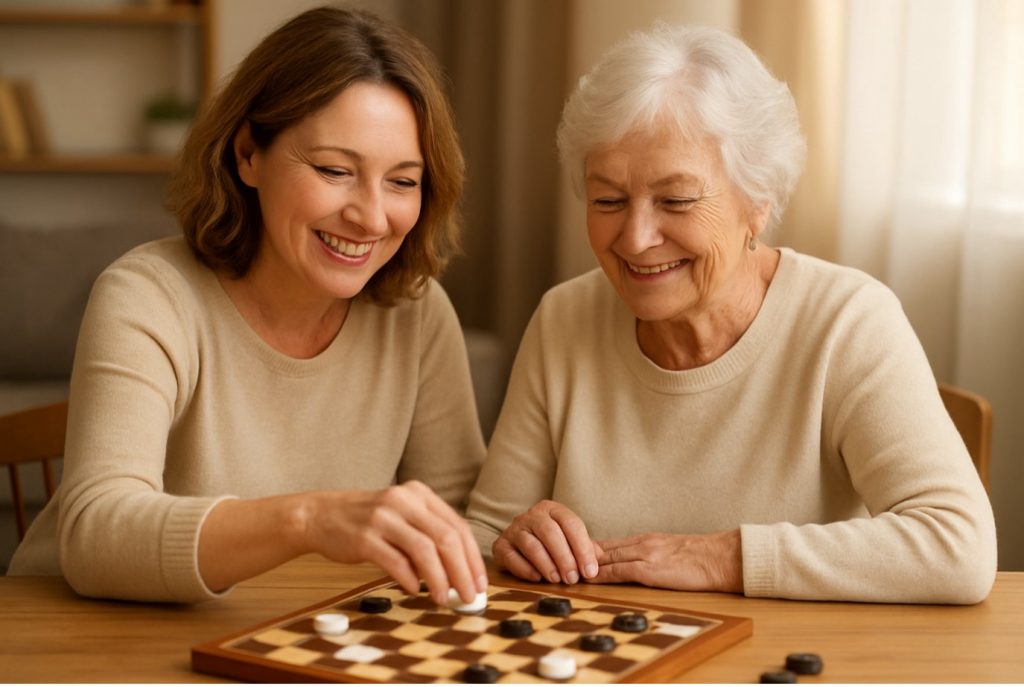
Being cared for can also feel stressful. Adapting to new routines, accepting personal support and coping with physical or mental changes can be difficult. That is why a warm, understanding and familiar care environment is so important.
To support this, Good Souls has developed Social Analysis for Care Matching. This approach helps families understand not only a caregiver’s professional skills, but also their personality, hobbies, values and communication style.
Through thoughtful Caregiver Matching and Care Matching, families can Find the Right Caregiver for their loved ones. With Good Souls, Social Home Care means creating a safe, respectful and human care environment where seniors can feel understood, supported and valued.
The value of social analysis when choosing a caregiver
When people talk about care in Germany, they discuss the level of care, the costs of care, care needs, technical infrastructure, language skills, and service providers. The topic of care is approached in a factual and analytical manner, and the processes involved are standardized. There are clear checklists designed to guarantee good care. This is important to all of us.
But what does “good care” mean when we take a moment to think about it? Of course, all hygienic, medical, and care-related processes must function smoothly. This definitely increases life expectancy and quality of life. But does this alone positively stimulate the joys of life and make people happy?
At good souls, we pay attention not only to general care standards but also to the interpersonal cognitive effect. We know that engaging in hobbies that have been cherished for decades increases patients’ well-being and maintains their self-esteem. Shared areas of interest, incorporated into everyday life, ensure that mental abilities and joie de vivre are preserved for longer in old age.
It is also important to consider that receiving care can be stressful for patients. Being washed, adhering to unfamiliar routines, and coping with changing structures while mental and physical abilities decline can be exhausting. All of this takes a toll on the mind and body and triggers symptoms of stress. It is therefore important that these completely natural but negative reactions to the autonomic nervous system are counteracted by an inclusive environment and transformed into happy, energizing moments.
On this basis, we at good souls have developed social analysis. People who have opened their hearts to caregiving not only share their professional skills and qualifications with families in Germany, but also talk about their characteristics and hobbies, which they will bring to bear in the event of a home care assignment. In this way, families can create an environment for their loved ones in need of care at home where they feel safe and secure and can share and pursue their interests. Numerous scientific studies have shown that a socially optimized environment helps people live longer, healthier, and happier lives. With our social analysis, we make this possible for you and your loved ones. Care is more than a service; it means being allowed to be human. Feel free to use the good souls social analysis for this purpose.
Get In Touch
Tell us what interests you. We won’t leave you alone with your thoughts. You can call us, send us an email, or write us a letter. We look forward to helping you
Good Souls Pflegevermittlung GmbH
Brunowall 28, 59494 Soest
info@good-souls-pflege.de
Response within 4 hours